
Introduction
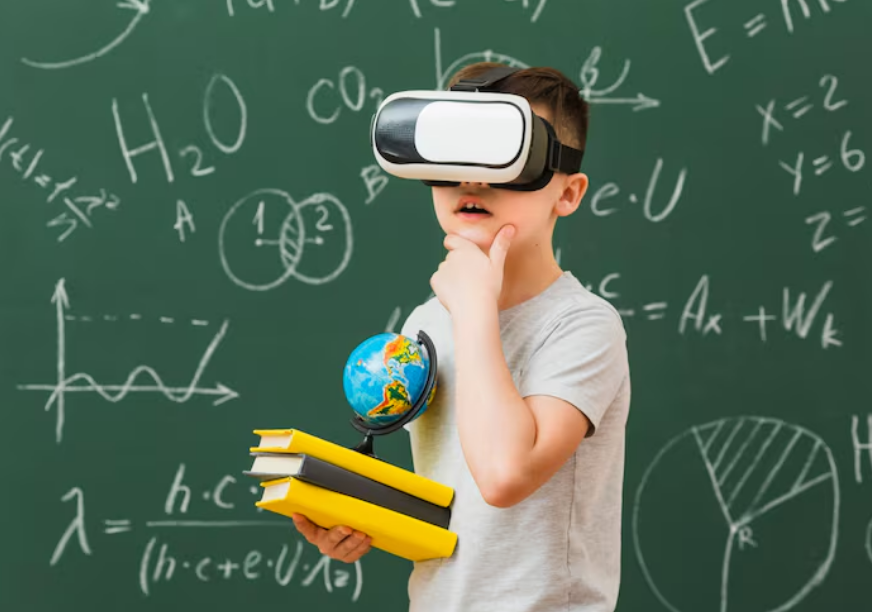
Mathematics has always been an essential subject in education, yet many students struggle to understand abstract concepts through traditional teaching methods. Complex equations, geometric structures, and spatial relationships can be difficult to visualize when presented only in textbooks or on classroom boards. Spatial computing is introducing a new approach to mathematics education by allowing students to explore mathematical ideas in interactive three-dimensional environments.
By combining augmented reality (AR), virtual reality (VR), and advanced digital visualization, spatial computing creates immersive learning experiences that make mathematical concepts more accessible, engaging, and practical.
Understanding Spatial Computing in Education
Spatial computing refers to technology that enables digital objects and information to interact with physical or virtual environments. In education, it allows students to manipulate three-dimensional models, explore virtual spaces, and interact with mathematical representations.
Unlike traditional educational tools, spatial computing encourages active participation. Students can rotate geometric shapes, examine mathematical relationships, and observe how changes in variables influence visual outcomes.
For example, rather than memorizing formulas for calculating the volume of a cylinder, students can interact with a virtual cylinder, modify its dimensions, and observe how the volume changes.
This hands-on approach helps connect theoretical knowledge with visual understanding.
Making Abstract Mathematical Concepts Visible
One of the greatest advantages of spatial computing is its ability to transform abstract mathematical ideas into interactive visual experiences.
Concepts such as geometry, algebra, calculus, and coordinate systems become easier to explore when represented in three dimensions.
Students studying geometry can examine polygons, prisms, spheres, and other structures from multiple perspectives. They can also investigate angles, symmetry, surface area, and volume through direct interaction.
In algebra, spatial visualization can demonstrate relationships between equations and graphs. Students can adjust variables and observe how mathematical functions change in real time.
These experiences can support deeper understanding by allowing learners to investigate mathematical principles instead of relying exclusively on memorization.
Encouraging Interactive and Experiential Learning
Traditional mathematics lessons often involve listening to explanations, solving written problems, and completing exercises. Although these methods remain valuable, spatial computing introduces opportunities for experiential learning.
Students can participate in activities such as constructing virtual geometric models, exploring coordinate planes, and testing mathematical predictions.
For instance, a teacher could create a virtual environment where students build bridges using geometric structures. Learners could investigate how triangles contribute to structural stability while applying principles of measurement and spatial reasoning.
Such activities connect mathematical learning with practical situations, encouraging curiosity and problem-solving.
Improving Spatial Reasoning and Critical Thinking
Spatial reasoning is the ability to understand relationships between objects, shapes, and positions. It plays an important role in mathematics, engineering, architecture, and scientific problem-solving.
Spatial computing can provide opportunities to develop these skills through interactive exercises.
Students might explore how three-dimensional objects appear from different viewpoints or predict the results of rotating and transforming shapes.
These activities encourage learners to think critically, recognize patterns, and develop logical explanations.
As students become more comfortable interpreting spatial information, they may find it easier to approach challenging mathematical problems.
Supporting Different Learning Styles and Needs
Students learn mathematics at different speeds and benefit from different forms of instruction. Some understand concepts through written explanations, while others respond better to visual demonstrations or practical activities.
Spatial computing offers teachers additional ways to present mathematical information.
Interactive models can help visual learners understand complex relationships, while hands-on activities may benefit students who learn through experimentation.
Teachers can also adjust the complexity of activities according to student abilities.
However, immersive technology should complement traditional teaching rather than replace it. Accessible alternatives are important for students who cannot comfortably use VR headsets or other specialized devices.
Promoting Collaboration in Mathematics Classrooms
Spatial computing can also create opportunities for collaborative learning.
Students can work together to solve mathematical challenges, examine virtual models, and discuss different approaches to a problem.
For example, a group might collaborate on designing a virtual building while calculating dimensions, angles, and proportions.
Through these activities, students develop communication, teamwork, and problem-solving skills alongside mathematical knowledge.
Teachers can guide discussions and encourage learners to explain the reasoning behind their decisions.
Challenges of Implementing Spatial Computing
Despite its educational potential, spatial computing presents several challenges.
The cost of specialized equipment, software, and technical infrastructure can make adoption difficult for some schools.
Teachers may also require professional training to integrate immersive technology effectively into mathematics lessons.
Other considerations include device accessibility, student privacy, classroom management, and ensuring that technology supports meaningful educational outcomes.
Schools should therefore introduce spatial computing gradually, focusing on specific learning objectives rather than adopting technology simply because it is innovative.
The Future of Mathematics Education
As immersive technologies become more accessible, spatial computing could play an increasingly important role in classroom instruction.
Future educational applications may offer personalized mathematical simulations, collaborative virtual environments, and interactive lessons tailored to individual learning progress.
Artificial intelligence could also support these experiences by providing feedback and adapting mathematical challenges to students’ understanding.
However, successful implementation will depend on thoughtful lesson design, teacher preparation, and evidence that these tools improve learning outcomes.
Conclusion
Spatial computing represents a promising development in mathematics education by transforming abstract ideas into interactive three-dimensional experiences. Through immersive visualization, experimentation, and collaborative activities, students can explore mathematical relationships in ways that traditional materials cannot always provide.
While challenges involving cost, accessibility, and teacher training remain, spatial computing has the potential to make mathematics more engaging and understandable.
When integrated thoughtfully with established teaching methods, this technology can help students build stronger mathematical foundations and develop valuable problem-solving skills for the future.
Read More : Acoustic Dampening Aesthetics: Integrating Sound Absorption into Modern Living Rooms